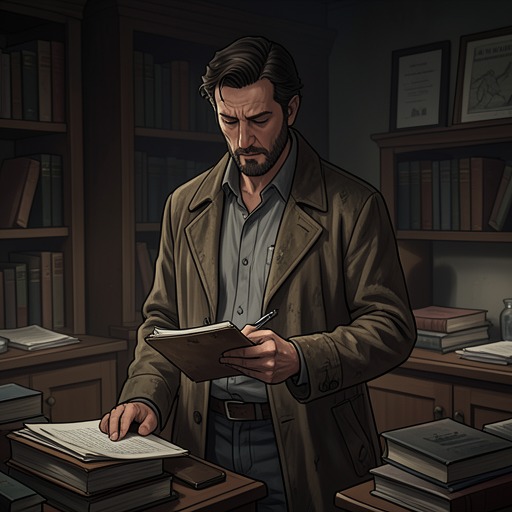
Writing as an Artistic Vocation
Martin EdenWriting as an Artistic Vocation is the conviction that Martin Eden can turn experience into language and thereby let others see, hear, and feel through him. It begins amid his self-education at sea, becomes bound up with his love for Ruth Morse, and drives him into an intense practice of prose and poetry. The vocation gives his life direction and joy, but it also sets an ideal of expression against the slow, discouraging business of getting work accepted.
The vocation takes shape
During the eight months of the treasure-hunting expedition, Martin studies with the same determination he brings to physical work. He goes through grammar repeatedly, adds twenty dictionary words to his vocabulary each day, and rehearses pronunciations and common phrases while on watch or at the wheel. He borrows Shakespeare from the captain in return for washing his clothes; the plays train his ear for elevated English, even as their archaic language enters his own mind. His studies make him more conscious both of how much he does not know and of the capacity he feels within himself.
That sense of capacity becomes a wish to create. The South Sea beauty around him seems to demand more than private appreciation: at first he imagines describing it to Ruth, then realizes that he wants to recreate it for a wider audience. Writing, in his conception, would make him one of the means through which the world could be seen, heard, and felt. He imagines working in every form he can name, from poetry and prose to fiction, description, and plays. Literature appears to him as a higher distinction than the wealth and public standing represented by Mr. Butler, and as a possible career as well as a means of proving himself worthy of Ruth.
An ideal joined to love and ambition
The return voyage to San Francisco gives Martin distance from Ruth’s world and a new sense that he can understand it as a whole. He sees writing as a way to enter that world and master its unfamiliar codes. His first plan is practical: describe the treasure-hunters’ voyage and sell the account to a newspaper. He expects to keep studying while he writes and, initially, hopes only to earn enough to continue his education. Fame and a more ambitious literary achievement belong to a later, uncertain future; the deepest personal purpose he attaches to the dream is to become worthy of Ruth.
His encounter with Ruth makes the artistic problem more intimate. He wants to share a vision of sunlit spaces and starry distances with her, but feels the inadequacy of what he can say. The image of a dog asleep in the sun, unable to communicate what it sees, gives form to his frustration: he can perceive beauty but cannot yet make language carry it to another person. He understands the great writers as people who have learned to make words express more than their separate meanings. That recognition turns his desire to write into a desire to acquire the power of expression itself.
Practice, experiment, and creative pleasure
Back in Oakland, Martin initially stays away from Ruth so that he can finish his account of the expedition before visiting her. He studies the length of a Sunday supplement article to guide his own, completes his narrative in three days, and then discovers in a rhetoric book that he must attend to paragraphs and quotation marks. The episode places his ambition at the beginning of an apprenticeship: inspiration may set the work in motion, but craft has to be learned through study and revision.
His early efforts range beyond that first article. He tries to write love poems inspired by Ruth, but cannot capture the elusive quality he senses in great poetry. Rhyme, meter, and structure can be made technically sound, yet the inner glow he wants to convey remains beyond his grasp. When the poems disappoint him, he returns to prose, which he finds easier to handle. He then writes about pearl-diving, the sea as a career, turtle-catching, and the northeast trade winds before trying a short story. Six stories follow, and he sends them to magazines.
Writing becomes the center of a crowded daily life. Martin works from morning until late at night, stopping for study, library visits, and calls on Ruth. He reduces sleep to five hours because there is more he wants to learn and write than the day seems to allow. Creation brings him a sustained happiness: the difficult surroundings of his Oakland home recede as the world of his imagination becomes, for him, the more substantial reality. His work is not yet a secure livelihood, but the act of making it feels like a form of life in its own right.
Rejection and the persistence of the work
The first responses from publishers make the gap between vocation and career concrete. The Youth’s Companion returns his adventure serial after a month with a tactful rejection. Martin waits for the San Francisco Examiner, writes twice to its editor, and goes in person, only to be turned away by the office boy. After five weeks, the manuscript comes back without explanation. Other newspapers and magazines return his articles and stories, often with printed rejection slips. He rereads his stories, unable to understand why work he values is refused, then learns that manuscripts should be typewritten and rents a typewriter to prepare them accordingly. Even this adjustment does not bring immediate acceptance; typed work begins coming back too.
The rejections do not extinguish his creative drive. Martin continues to study, including physics and navigation, and keeps writing fiction while experimenting with verse. A tragedy in blank verse is rejected by several magazines, but he turns next to a series of sea poems called Sea Lyrics. He completes thirty in a month, one a day after the substantial day’s work he already puts into fiction. He regards them as his best work so far, a release of beauty and feeling that had remained pent behind his inarticulate speech.
The private audience and the meaning of vocation
Martin does not submit the Sea Lyrics to editors, nor does he show them to anyone else. He keeps them for a hoped-for future when he will dare to read them to Ruth, repeatedly going over the poems until he knows them by heart. The choice reveals how closely his artistic ambition remains tied to a particular listener, even as his initial vision had expanded from describing beauty to reaching a wider audience. His wish to communicate is public in scope but, at this stage, privately oriented toward Ruth.
The vocation therefore holds together several desires that do not always align: earning a living through writing, continuing his education, achieving literary distinction, and making beauty communicable to someone he loves. Its early history is not a tale of recognition but of effort before recognition: daily language drills, unfinished poems, articles and stories sent out, manuscripts returned, and new forms attempted. The work gives Martin purpose and creative joy, while the recurring rejections show that artistic conviction alone cannot secure a place in the literary marketplace.